Vocalist. Actress. Ambassador. An American Treasure. That, in part, describes the life and talent of singer Pearl Bailey. Born in Newport News, Virginia at the end of World War One, her father was a pastor and her brother Bill a professional tap dancer. From an early age, Pearl had a talent for singing and often sang in her father Joseph’s church. Brother Bill suggested she enter an amateur contest at a theatre in Philadelphia, where she won first place at the age of fifteen and was offered her first singing job. She later won a similar competition at the Apollo Theater in New York City’s Harlem and from there pursued her career in entertainment.
PEARL BAILEY - Jingle Bells Cha Cha Cha Roulette 4206 1959 - Duration: 2 minutes, 18 seconds. Overview of all albums from Pearl Bailey. Close this message. This site uses cookies. For more information, follow this link.Here you can read more about which cookies we place, and why and which possible '3rd-party' cookies can be added.
Initially Bailey sang and danced in Vaudeville, appearing in various nightclubs in Philadelphia in the ‘30s, and shortly thereafter began performing along the East Coast. Her solo successes as a nightclub entertainer were followed by performances with such musical stars of the period as Cab Calloway and Duke Ellington. By the start of the Second World War, Bailey toured the country performing with the USO, where her talent and cleaver stage banter quickly make her a favorite with American troops. After the war ended, Pearl settled in New York.
Pearl Bailey The Best Of The Roulette Years
In 1946, Bailey made her Broadway debut in ‘Saint Louis Woman’. For her performance, she won a Donaldson Award as the best Broadway newcomer. However, Bailey’s most important and popular Broadway role would be as Dolly Levi in the all-black version of ‘Hello Dolly!’ where she won a Tony Award for the title role. The performance was so successful it played to sold-out houses and RCA Victor made an original cast album. Bailey continued to tour and record albums in between her stage and screen performances.
Her rendition of “Takes Two to Tango” hit the top ten in 1952. In the fall of that same year, Bailey married jazz drummer Louie Bellson in London. They adopted a boy, Tony, in the mid-1950s. A girl, Dee Dee J. Bellson, was born in 1960.
Throughout the ‘60s and ‘70s, Pearl appeared on countless television variety shows and hosted her own variety series on ABC, ‘The Pearl Bailey Show’. In addition to television appearances, she continued to record and perform in live concert settings and received the Screen Actors Guild Life Achievement Award. Bailey returned to Broadway in 1975, once again playing the lead in ‘Hello, Dolly!’, and that same year was appointed special ambassador to the United Nations by President Gerald Ford.
A passionate baseball fan, Bailey sang the national anthem prior to game five of the ‘69 World Series, and again sang the national anthem prior to game one of the ‘81 World Series between the New York Yankees and Los Angeles Dodgers at Yankee Stadium. She earned a degree in theology from Georgetown University in Washington, D.C., in 1985.
In 1988 Bailey received the Presidential Medal of Freedom from President Reagan.
Pearl Bailey died at in Philadelphia on August 17, 1990. Bailey is buried at Rolling Green Memorial Park in West Chester, Pennsylvania.
Artist Biography by John Bush
An uninhibited vocalist who gave more to her performances than any other singers around, Pearl Bailey gained fame for her work in Broadway, cabaret, and Hollywood. Bailey's sultry, slurred delivery livened up many a stale standard, including 'Baby It's Cold Outside' and her only hit, 'Takes Two to Tango.'
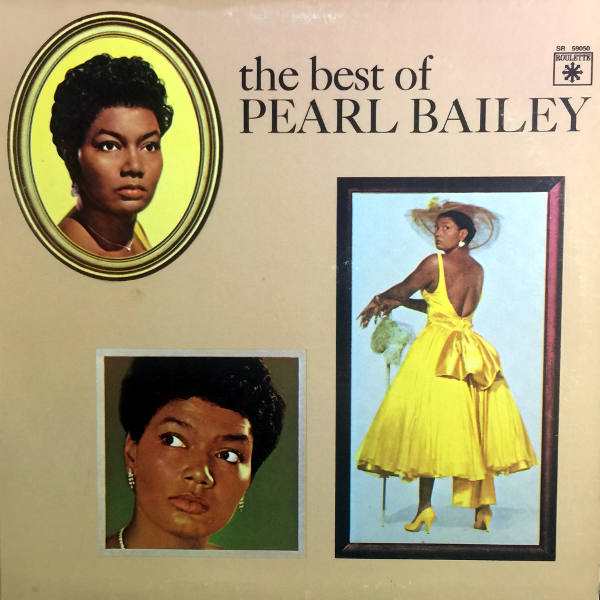
The daughter of a preacher, Bailey began singing at the age of three (her brother, Bill Bailey, also taught her a few dance steps). She was performing professionally by her early teenage years and after touring as a dancer for several years, she featured both as a singer and dancer with jazz bands led by Noble Sissle, Cootie Williams, and Edgar Hayes. She began performing as a solo act in 1944, and wooed night club audiences with her relaxed stage presence and humorous asides. After briefly replacing Sister Rosetta Tharpe in Cab Calloway's Orchestra during the mid-'40s, she debuted on Broadway during 1946 in the musical St. Louis Woman. Bailey earned an award for most promising newcomer, and made her first film, Variety Girl, in 1947.
Though it wasn't a hit, her version of 'Tired' (from Variety Girl) increased her standing in the jazz community. She recorded for several different labels, including Columbia, during the '40s and finally found a hit in 1952 after signing to Coral. Her version of 'Takes Two to Tango,' backed by Don Redman's Orchestra, hit the Top Ten. That same year, she married drummer Louie Bellson, and he left his position with Duke Ellington to become her musical director. Bailey recorded several albums for Coral during the early '50s, and starred as a fortune teller in the 1954 film Carmen Jones. More starring roles followed, in the W.C. Handy biopic St. Louis Blues as well as the first filmed version of Gershwin's classic operetta Porgy and Bess.
In 1959, a new recording contract (with Roulette) resulted in a change of direction. After her double-entendre LP For Adults Only was banned from radio play, it became a big seller and occasioned a string of similar albums during the early '60s. She continued to perform on Broadway, and won a Tony award in 1970 for her title role in Hello, Dolly!. She led her own television variety show in 1971, but retired from active performance several years later. Pearl Bailey was named to the American delegation to the United Nations in 1976, and awarded the Medal of Freedom in 1988.