The title is the London address of the fictional pair, Sherlock Holmes and Dr Watson. 221b Baker Street. I didn't now there were any really good modern sonnets. The 9th line is perhaps a bit too close to T.S. Eliot - 'The yellow fog that rubs its back upon the window-panes' (The Love Song of J. Alfred Prufrock). Jan 08, 2014 Baker Street always has existed. But At the time the Holmes stories were published, addresses in Baker Street did not go as high as 221. Baker Street was later extended, and in 1932 the Abbey National Building Society moved into premises at 219–22. That address: 221b Baker Street, as famous as it was unreal, was the residence of Holmes, and occasionally his friend Dr. Watson, and the starting point to many adventures. It was a kind of psychic center to which all the Empire’s evil flooded. Permanently shrouded in late autumnal fog, it was there its occupants heard the inevitable knock.
221B Baker Street: The Master Detective Game is a board game featuring Arthur Conan Doyle's fictional detective Sherlock Holmes and developed by Jay Moriarty (dba Antler Productions) in 1975[1] and sold by the John N. Hansen Co. in the US since 1977. The players have to solve cases using the clues provided by visiting locations on the board such as 221B Baker Street, Scotland Yard, Apothecary and Pawn Broker.
The original game has twenty cases, but there are eight expansion sets of 20 cases each for a total of 180 cases available for play, created thru 1986. A new Deluxe Edition of 221 B Baker Street, published by Hansen, has been released in the U.S. in 2016. This Deluxe Edition contains the original 180 cases plus 20 all-new cases for a complete set of 200 cases. The Deluxe Edition also includes all new artwork, board design, and collectible Sherlockian metal tokens. The original game has been licensed for sale in the UK (Gibsons Games), Canada, Australia, New Zealand, Brazil and Romania. Editions of the game published by Gibson have reproduced almost 40 of the 180 cases of the Hansen edition (basically taking from the 20 original cases plus the 20 from the first expansion), but also included 60 new cases for a total of 100. Their recent 2014 edition has 75 cases taken from their 100. The Brazilian version is titled Scotland Yard and translated in Portuguese.
A sequel game, 221 B Baker Street: Sherlock Holmes and the Time Machine came out around 1996, but is no longer published in the U.S. However, a Time Machine version of the game has been released in Brazil (2016–17) titled Scotland Yard: Sherlock Holmes & The Time Machine and features 40 cases.
Gameplay[edit]
Before the game starts, a case is selected, and one player reads the case file. This fills in the players on the background of the case as well as listing the location of each clue in the case booklet. A place may provide no clue, or only a part of one. Clues may also be entirely irrelevant, or throw a player off entirely. Clues often are in the form of a riddle, especially multi-part clues.
Play begins with each player at 221B Baker Street, from which the players visit each of the 14 locations on the board. Movement is decided by the throw of a single die.
Upon entering a location the player may read the back of the card containing the case. This consists of a list of locations and a number assigned to each one. The player may then secretly read the relevant paragraph in the back of the rulebook which is the clue. (The numbers are mixed up so two adjacent numbers in the book are unlikely to be from the same case.)
Each paragraph may or may not contain evidence of note and the clue may be cryptic. A time limit to read the clue is recommended after which the book must be closed and play passed to the next player. If a person wishes more time (or needs to check again) then he must stay for an extra move (or return to the location if previously vacated) to get another attempt. Allowing some players (e.g. children playing) more time than others is not unknown.
If the player believes that they know the solution to the case, they may return to the starting point. Upon returning to the starting point the player must announce (publicly) the essentials of the crime: typically the culprit, the weapon used and the motive. Some cases (scenarios) may require other items to be revealed - e.g. culprit, motive, location of stolen items. This is outlined in the case introduction. Having read aloud their solution, they inspect the rulebook and look up the entry given for the correct solution. If correct they must read it aloud to confirm. If not they stay silent except to announce their failure and are excluded from the game. It is possible for all players to be excluded.
Three additional 'twists' (or tactics) are available. The Carriage Depot (one of the locations) can also be used to move immediately to any point on the board, in which case they cannot view the clue although they may view the clue, then wait for their next turn before taking a carriage. Also, each player begins the game with two markers, one is a key and the other a warrant. Upon leaving a location the player may use their warrant to bar access to all other players who must expend their own key card to remove it. Only one of each card may be held by a player at one time, although replacements may be gained by visiting Scotland Yard or the Locksmith's (both locations with clues). 221B, Scotland Yard and the Locksmith's may not themselves be sealed with a warrant. A warrant can be used to obstruct other players to locations with helpful clues or placed in locations with useless clues to convince other players such a location is useful.
Format of Clues[edit]
Clues come in three basic forms:
- Descriptive: E.g. 'Mr. Fowler, the Baker's assistant, was seen arguing with Mrs. Turnbuckle (the victim) earlier that evening about his unpaid rent.' or 'Holmes reasons that a petty pickpocket, such as Hobson, would not by himself know how to break a bank safe.' This may or may not be relevant. In the case of the latter it points either to an accomplice (who also must be identified in the solution), or that Hobbs has otherwise unknown skills or that Hobbs is not involved. In the case of the former it may reveal both the killer and potential motive (Fowler killed Mrs. Turnbuckle over unpaid rent) or it might be simple coincidence. Another possibility might be: 'Although everyone heard three shots, only one chamber in the revolver found at the scene had been expended.' This (more indirect clue) would need careful consideration. Was there more than 1 weapon? Or had the weapon been reloaded? If reloaded, then by whom and when? And in either result what does this mean for the case?
- No Clue. Literally as stated.
- Weapon/Killer/Motive Clue: E.g. 'Motive Clue (3 Parts): I - Extremely Cold'. In this case the clue is assembled like a game of charades, forming syllables, words or phrases from clues which must be assembled. The full sentence composed of all its parts will often then be a cryptic statement pointing to the solution or a literal spelling of the solution. For example, a two-part killer clue might spell the offender's name. The 'I' at the beginning of the example given indicates this is the first syllable/word/fragment of a phrase that contains three fragments. The other two will be in other locations.
Locations[edit]
- 221B Baker Street (Start/End Location, never any clues associated.)
- Chemist
- Bank
- Carriage Depot
- Docks (can be accessed from two points of which one must remain unsealed.)
- Hotel
- Locksmith (provides new keys, cannot be sealed)
- Museum
- Newsagent's
- Park (3 Entrance paths, one must remain unsealed.)
- Pawnbroker
- Theater
- Boar's Head
- Tobacconist
- Scotland Yard (replaces used warrants, cannot be blocked by one.)
The two locations with multiple entrance/exit positions can be used to gain a short-cut. The player must stop upon entering (viewing the clue or not) but can leave one turn later. In the case of a 'race to the end' (two players making all speed to reach 221B first to announce their solution) this is invaluable in the case of the Park as it occupies a whole stretch of the board and one end is directly adjacent to 221B. With average die rolls it would take 6 moves to move the whole length of the park by normal means rather than the two used by moving through it. The carriage depot (should it be closer) is also invaluable in this 'race to the end' situation. In the new Deluxe Edition, a new board is used, and the park and carriage depot have been moved, eliminating this technique
Additional notes on Tactics[edit]
Many novice players begin at 221B and then progress across the board. Another tactic is to move to the Park (directly adjacent to 221B), read the clue and then move (due to the large size of the park location) to the carriage depot. Upon reading the clue at the depot, take a carriage to the docks (the furthest point from 221B) or a nearby location to the docks. In that way the player works 'backwards' across the board (back towards 221B rather than away from it), and so after gaining many clues will be closer to 221B than a player who worked from 221B outwards (and so might be the opposite side of the board - and hence the furthest distance from the 'end' at 221B when enough clues are read to provide the solution.)
Expansion Sets[edit]
8 expansion sets with additional cases are published, numbered from 2 to 9. They can be purchased separately or are all available in the new Deluxe edition, which includes the complete set of 180 cases, plus 20 more. A ninth set has now been published with the 20 new cases.
References[edit]
- ^'221B Baker Street: The Master Detective Game | Board Game | BoardGameGeek'. boardgamegeek.com. BoardGameGeek. Retrieved 16 May 2015.
External links[edit]
- 221B Baker Street at BoardGameGeek

221B Baker Street is the London address of the fictional detective Sherlock Holmes, created by author Sir Arthur Conan Doyle. In the United Kingdom, postal addresses with a number followed by a letter may indicate a separate address within a larger, often residential building. Baker Street in the late 19th century was a high-class residential district, and Holmes' apartment would probably have been part of a Georgianterrace.
At the time the Holmes stories were published, addresses in Baker Street did not go as high as 221. Baker Street was later extended, and in 1932 the Abbey National Building Society moved into premises at 219–229 Baker Street. For many years, Abbey National employed a full-time secretary to answer mail addressed to Sherlock Holmes. In 1990, a blue plaque signifying 221B Baker Street was installed at the Sherlock Holmes Museum, situated elsewhere on the same block, and there followed a 15-year dispute between Abbey National and the Holmes Museum for the right to receive mail addressed to 221B Baker Street.[1] Since the closure of Abbey House in 2005, ownership of the address by the Holmes Museum has not been challenged, despite its location between 237 and 241 Baker Street.
- 2Real 221B Baker Street addresses
Conan Doyle's intentions[edit]
We met next day as he had arranged, and inspected the rooms at No. 221B, Baker Street, of which he had spoken at our meeting. They consisted of a couple of comfortable bed-rooms and a single large airy sitting-room, cheerfully furnished, and illuminated by two broad windows.
When the 'Sherlock Holmes' stories were first published, street numbers in Baker Street did not go as high as 221.
The section north of Marylebone Road near Regent's Park – now including 221 Baker Street – was known in Conan Doyle's lifetime as Upper Baker Street. In his first manuscript, Conan Doyle put Holmes' house in Upper Baker Street. However, a British crime novelist named Nigel Morland claimed that, late in Conan Doyle's life, he identified the junction of Baker Street and George Street, about 500 metres south of the Marylebone Road, as the location of 221B. Sherlockian experts have also held to alternative theories as to where the original 221B was located and have maintained that it was further down Baker Street.[2]
Real 221B Baker Street addresses[edit]
Abbey National[edit]

When street numbers were reallocated in the 1930s, the block of odd numbers from 215 to 229 was assigned to an Art Deco building known as Abbey House, constructed in 1932 for the Abbey Road Building Society, which the society and its successor (which subsequently became Abbey National plc) occupied until 2002.[1]
Almost immediately, the building society started receiving correspondence from Sherlock Holmes fans all over the world, in such volumes that it appointed a permanent 'secretary to Sherlock Holmes' to deal with it. A bronze plaque on the front of Abbey House carried a picture of Holmes and a quotation, but was removed from the building several years ago. Its present whereabouts are unknown. In 1999, Abbey National sponsored the creation of a bronze statue of Sherlock Holmes that now stands at the entrance to Baker Street Underground station.
Sherlock Holmes Museum[edit]
Is There A Real 221b Baker St
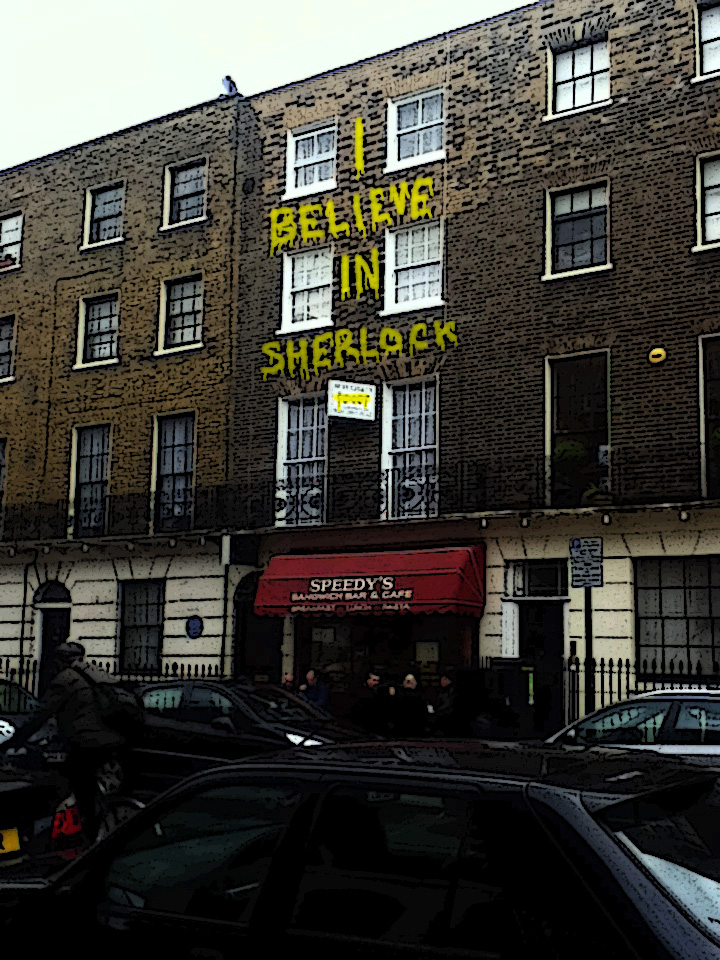
The Sherlock Holmes Museum is situated within an 1815 townhouse very similar to the 221B described in the stories and is located between 237 and 241 Baker Street. It displays exhibits in period rooms, wax figures and Holmes memorabilia, with the famous study overlooking Baker Street the highlight of the museum. The description of the house can be found throughout the stories, including the 17 steps leading from the ground-floor hallway to the first-floor study.[3]
According to the published stories, '221B Baker Street' was a suite of rooms on the first floor of a lodging house above a flight of 17 steps.[3] The main study overlooked Baker Street, and Holmes' bedroom was adjacent to this room at the rear of the house, with Dr. Watson's bedroom being on the floor above, overlooking a rear yard that had a plane tree in it.[4][5]
Address controversy[edit]
The street number 221B was assigned to the Sherlock Holmes Museum on 27 March 1990 (replacing the logical address 239 Baker Street) when the Leader of Westminster City Council, Shirley Porter, unveiled a blue plaque signifying the address of 221B Baker Street. She was invited to renumber the museum's building to coincide with its official opening (and because the number 221B had not been included in the original planning consent for the museum granted in October 1989).
A long-running dispute over the number arose between the Sherlock Holmes Museum, the building society Abbey National (which had previously answered the mail addressed to Sherlock Holmes) and subsequently the local Westminster City Council. The main objection to the Museum's role in answering the letters was that the number 221B bestowed on the Museum by the Council was out of sequence with the other numbers in the street: an issue that has since vexed local bureaucrats, who have striven for years to keep street numbers in sequence. In 2005, Abbey National vacated their headquarters in Baker Street, which left the museum to battle with Westminster City Council to end the dispute over the number, which had created negative publicity. Eventually the museum was granted special permission by the City of Westminster to bear the address of 221B Baker Street.[1]
In 2018 Quartz revealed that, according to court documents and the Panama Papers, the property was owned at least partially by relatives of Nursultan Nazarbayev, the Kazakhstani president.[6]
Sherlock Holmes Pub[edit]
Another version of Sherlock Holmes' apartment is at The Sherlock Holmes pub in Northumberland Street near Charing Cross railway station. This was originally a small hotel, the Northumberland Arms, but was refurbished and reopened under its present name in December 1957. Its owners, Whitbread & Co, owned the entire Sherlock Holmes exhibition put together by Marylebone Borough Library and the Abbey National for the 1951 Festival of Britain. The pub was restored to a late Victorian form and the exhibit, a detailed replica of Holmes' fictional apartment, was installed on the upstairs floor.
In the United States, there is a pub/restaurant chain named 'Baker Street Pub,' that plays on the Sherlock Holmes theme.[7] Some locations even have the iconic British red phone booth outside.[8]
In other media[edit]
221b Baker Street London England
The fictional address has been portrayed in the following pastiches of Sherlock Holmes:
Is There Really A 221b Baker Street In London
- Basil of Baker Street resides in 221+1/2 Baker Street, a mouse-hole beneath 221B Baker Street.[9]
- Private detective Louie Knight moves into an office at 22/1B Stryd-y-Popty (which translates as Baker Street in Welsh) in Malcolm Pryce's Welsh Noir parody The Unbearable Lightness of Being in Aberystwyth.
- The 1987 CBS movie The Return of Sherlock Holmes (not to be confused with the 1986 British television series of the same name) features Holmes, cryogenically frozen in 1899 and awakened in modern times, trying to adapt with the aid of Watson's granddaughter, Jane. He seeks out his old residence and finds the spot occupied by a McDonald's franchise.[10]
- Dr. Gregory House, the protagonist of House, M.D., lives at 221 Baker Street, Apartment B, Princeton, NJ.[11]
- Danger Mouse, in the cartoon show of the same name, lives in a pillar box near 221b Baker Street.[12] However, Danger Mouse is a loose parody of Danger Man and James Bond, rather than Sherlock Holmes. The pillar box is a stone's throw away from 221B Baker Street and Dr. Watson throws stones at them in apparent jealousy that he only works for the world's greatest detective, not the world's greatest secret agent in the episode 'Where There's a Well, There's a Way'.
- In the Phryne Fisher series by Kerry Greenwood, the detective Hon. Phryne Fisher resides at 221 The Esplanade, St Kilda (Melbourne, Australia), which she renumbers to 221B in homage to Holmes.[13]
- In Star Trek: The Next Generation, Data tells another crew member that Geordi La Forge can be found at 221b Baker St, episode 29 'Elementary, Dear Data', and 221b Baker St. is again referenced in episode 137 'Ship in a Bottle'.[14]
- In Season 2, Episode 1 of Elementary, Sherlock Holmes and Joan Watson visit London and stay in a second floor residence numbered 221B. Sherlock indicates he had happily resided there before his move to New York City.[15]
- In the 2015 film Mr. Holmes, a long-retired Holmes (Ian McKellen) remarks that the Baker Street address is one of several fictitious details created by Watson, who wrote the cases up as sensationalist stories for publication. In a flashback, as curious onlookers gather outside 221B, Holmes watches from a window of his actual residence nearby and congratulates a client for finding the right address.[16]
- The BBC Television series Sherlock has used 187 North Gower Street to represent 221B Baker Street for shooting the exterior scenes of Sherlock Holmes' flat. The location is near Euston railway station, and roughly a mile away from the real Baker Street.[17]
- In the 2012–15 Australian television series Miss Fisher's Murder Mysteries, the title character of The Honourable Phryne Fisher (Essie Davis) lives at 221B Baker Street in Melbourne, Victoria.[18]
See also[edit]
- Sir Arthur Conan Doyle
Sherlock Holmes 221b Baker Street
References[edit]
- ^ abcStamp, Jimmy (18 July 2012). 'The Mystery of 221B Baker Street'. Smithsonian. Retrieved 23 November 2018.
- ^Holyroyd, James Edward (1994). Baker Street By-Ways. Otto Penzler Books. ISBN978-1-883402-71-6.
- ^ abConan Doyle, Arthur (1892), 'A Scandal in Bohemia', The Adventures of Sherlock Holmes, ISBN978-0-7607-1577-2 (
- 1661 at Project Gutenberg).
- ^Conan Doyle, Arthur (1927), 'The Problem of Thor Bridge', The Case-Book of Sherlock Holmes, ISBN978-0-7195-3012-8.
- ^'Sherlock Holmes 101', Washington Post, 11 January 2004
- ^Haldevang, Max de. '221b Baker Street and the president of Kazakhstan's daughter Dariga Nazarbayeva and grandson Nurali Aliyev'. Quartz. Retrieved 5 April 2018.
- ^'Baker St. Pub & Grill'. bakerstreetpub.com.
- ^'Sugar Land – Baker St. Pub & Grill'. bakerstreetpub.com.
- ^Alan Barnes (2002). Sherlock Holmes on Screen. Reynolds & Hearn Ltd. p. 55. ISBN1-903111-04-8.
- ^Alan Barnes (2002). Sherlock Holmes on Screen. Reynolds & Hearn Ltd. pp. 119–121. ISBN1-903111-04-8.
- ^Paunescu, Della (7 May 2018). '25 Things You Didn't Know About House'. Elle. Retrieved 26 November 2018.
- ^'How Danger Mouse became king of the TV ratings'. BBC. 11 October 2013. Retrieved 26 November 2018.
- ^Greenwood, Kerry (1990). Flying Too High. Australia: McPhee Gribble. ISBN978-0869142158.
- ^Alan Barnes (2002). Sherlock Holmes on Screen. Reynolds & Hearn Ltd. pp. 201–202. ISBN1-903111-04-8.
- ^Grubbs, Jefferson (30 October 2013). ''Elementary' Season 2 Recap Will Help You Solve the Case of Your Missing Memories Before Season 3 Premieres'. Bustle. Retrieved 27 November 2018.
- ^Kermode, Mark (22 June 2015). 'Mr Holmes review – the old sleuth on the trail of his younger self'. The Guardian. Retrieved 27 November 2018.
- ^Adams, Guy (2012). Sherlock: The Casebook. Titan Books. p. 7. ISBN978-1-84990-425-4.
- ^Burt, Katyl (8 March 2017). 'Miss Fisher's Murder Mysteries: The Feminist Sherlock You Should Be Watching'. Den of Geek. Retrieved 27 November 2018.
Where Is The Real 221b Baker Street
External links[edit]
Is There Really A 221b Baker Street In London
| Wikimedia Commons has media related to 221B Baker Street. |
- The Baker Street Journal an Irregular quarterly of Sherlockiana
Coordinates: 51°31′24″N0°09′30″W / 51.52333°N 0.15833°W