What is claimed is:
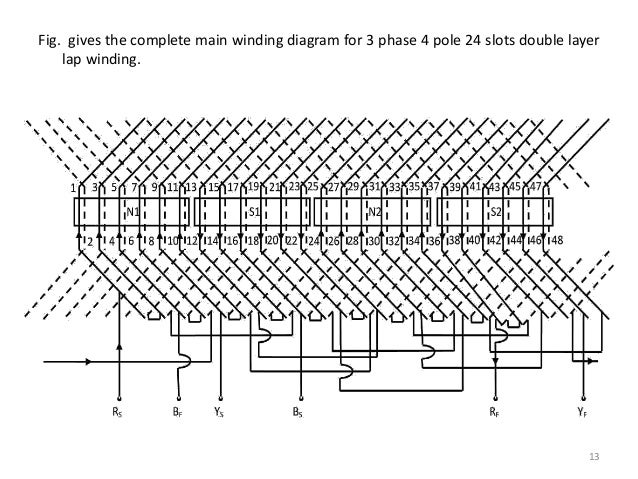
Jul 20, 2005 have a polarity 60 degrees apart (which creates a 12 pole motor with 36 slots), the effective winding is reduced to 1/4 of the ideal. I have not done all of the calculations, but the 2 pole and 4 pole designs should be close to ideal, but the 6 pole is probably reduced to about 50%, and it drops to 25% for 12 pole. Tips for recording the PWS winding of the refrigerant compressor. Please reload. PWS, Dual Voltage, 36 slots, 4 Pole. Another publication related to PWS windings is available to purchase here. PWS, Dual Voltage, 36 slots, 4 Pole, 24 Coils, 1Wye/2Wye Connection, 9 Leads, τd = 1,14%; WF = 0,9452.
1. A motor comprising:
a stator core;
36 Slot 2 Pole Winding Diagram
a rotor in rotational relationship with the stator core;
a shared main winding on the core having 2-pole and 4-pole configurations;
a shared auxiliary winding on the core having 2-pole and 4-pole configurations; and
a switching circuit for selectively simultaneously energizing the shared main winding and the shared auxiliary winding in the 2-pole and 4-pole configurations.
2. The motor of claim 1 wherein the shared auxiliary winding comprises a 4-pole auxiliary winding phase shifted at least one slot less than a 90 degree shift with respect to the phase of the shared main winding when energized in the four pole configuration.
3. The motor of claim 2 further comprising a single capacitor connected in series with the shared auxiliary winding and energized with the shared auxiliary winding when the shared auxiliary winding is energized with the shared main winding in the 2-pole configuration and connected in series with the shared auxiliary winding and energized with the shared auxiliary winding when the shared auxiliary winding is energized with the shared main winding in the 4-pole configuration.
4. The motor of claim 2 wherein the stator core has 36 slots and wherein the shared auxiliary winding has a phase shift of about 125 degrees with respect to the phase of the shared main winding when energized in the 2-pole configuration and wherein the shared auxiliary winding has a phase shift of about 70 degrees with respect to the phase of the shared main winding when energized in the 4-pole configuration.
5. The motor of claim 1 wherein the shared auxiliary winding has a phase shift which is not 90 degrees with respect to the phase of the shared main winding when energized in either of the first or second pole configurations.
6. The motor of claim 1 wherein the shared auxiliary winding has a phase shift of about X degrees with respect to the phase of the shared main winding when energized in the 2-pole configuration, wherein the shared auxiliary winding has a phase shift of about Y degrees with respect to the phase of the shared main winding when energized in the 4-pole configuration, and wherein X and Y are made to be as close as possible to about 90-105 degrees.
7. A motor having a 2-pole configuration and a 4-pole configuration comprising:
a stator core;
a rotor in rotational relationship with the stator core;
a shared main winding on the core which, when energized in the 2-pole configuration, generates a first main magnetic field and which, when energized in the 4-pole configuration generates a second main magnetic field different from the first main magnetic field;
a shared auxiliary winding on the core which, when energized in combination with the shared main winding in the 2-pole configuration, generates a first auxiliary magnetic field and which, when energized in the 4-pole configuration, generates a second auxiliary magnetic field different from the first auxiliary magnetic field; and
a switching circuit for selectively simultaneously energizing the shared main winding and the shared auxiliary winding in the 2-pole configuration and for selectively simultaneously energizing the shared main winding and the shared auxiliary winding in the 4-pole configuration.
8. The motor of claim 7 wherein the shared auxiliary winding comprises a 4-pole auxiliary winding phase shifted at least one slot less than a 90 degree shift with respect to the phase of the shared main winding when energized in the four pole configuration.
9. The motor of claim 8 further comprising a single capacitor connected in series with the shared auxiliary winding and energized with the shared auxiliary winding when the shared auxiliary winding is energized with the shared main winding in the 2-pole configuration and connected in series with the shared auxiliary winding and energized with the shared auxiliary winding when the shared auxiliary winding is energized with the shared main winding in the 4-pole configuration.
10. The motor of claim 8 wherein the shared auxiliary winding has a phase shift of about 125 degrees with respect to the phase of the shared main winding when energized in the 2-pole configuration and wherein the shared auxiliary winding has a phase shift of about 70 degrees with respect to the phase of the shared main winding when energized in the 4-pole configuration.
11. The motor of claim 7 wherein the shared auxiliary winding has a phase shift which is not 90 degrees with respect to the phase of the shared main winding when energized in either of the first or second pole configurations.
36 Slot 2 Pole Winding Pdf
12. The motor of claim 7 wherein the shared auxiliary winding has a phase shift of about X degrees with respect to the phase of the shared main winding when energized in the 2-pole configuration, wherein the shared auxiliary winding has a phase shift of about Y degrees with respect to the phase of the shared main winding when energized in the 4-pole configuration, and wherein X and Y are about 70-125 degrees.13. A method of making a motor comprising the steps of:
providing a stator core;
providing a rotor in rotational relationship with the stator core;
winding a shared main winding on the core having multiple pole configurations; and
winding a shared auxiliary winding on the core having multiple pole configurations.
14. The method of claim 13 wherein the shared main winding comprises a 2-pole main winding when energized in a first configuration and further comprises a 4-pole main winding when energized in a second configuration, and wherein the shared auxiliary winding is phase shifted at least one slot less than a 90 degree shift with respect to the phase of the shared main winding when energized in the 4-pole configuration.
15. The method of claim 14 further comprising the steps of connecting a single capacitor in series with the shared auxiliary winding so that it is energized with the shared auxiliary winding when the shared auxiliary winding is energized with the shared main winding in the 2-pole configuration and connecting the capacitor in series with the shared auxiliary winding so that it is energized with the shared auxiliary winding when the shared auxiliary winding is energized with the shared main winding in the 4-pole configuration.
16. The method of claim 14 wherein the shared auxiliary winding has a phase shift of about 125 degrees with respect to the phase of the shared main winding when energized in the 2-pole configuration and wherein the shared auxiliary winding has a phase shift of about 70 degrees with respect to the phase of the shared main winding when energized in the 4-pole configuration.
17. The method of claim 14 wherein the shared auxiliary winding has a phase shift which is not 90 degrees with respect to the phase of the shared main winding when energized in either of the 2 or 4-pole configurations.
18. The method of claim 14 wherein the shared auxiliary winding has a phase shift of about X degrees with respect to the phase of the shared main winding when energized in a 2-pole configuration, wherein the shared auxiliary winding has a phase shift of about Y degrees with respect to the phase of the shared main winding when energized in a 4-pole configuration, and further comprising the step of making X and Y to be about 70-125 degrees.